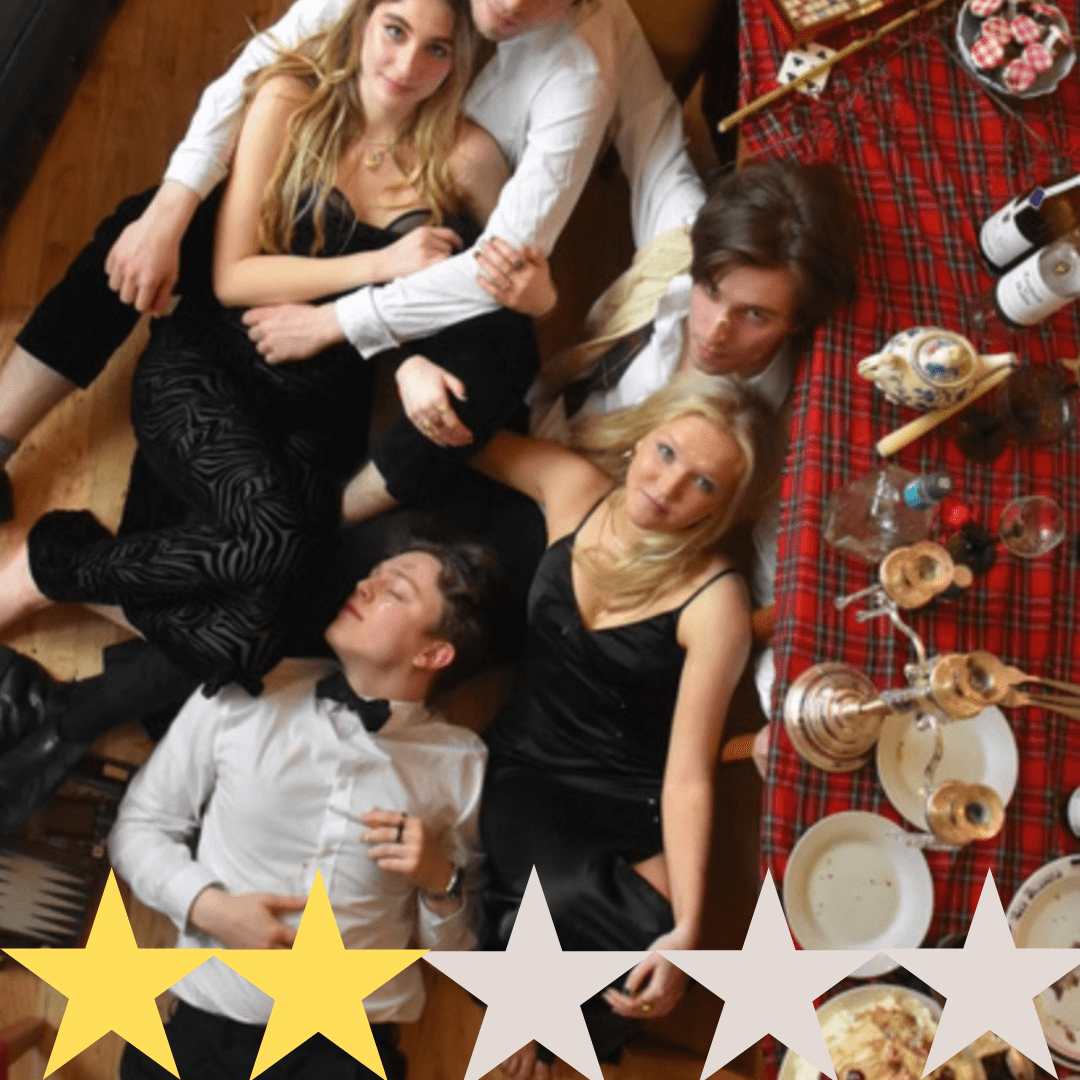
Zoo Playground, Edinburgh Fringe
Gossip Girl, Succession and now Trust. All of these shows are part of a curiously morbid fascination that fictional work has with the upper-classes; the wealth, status and drama of the world that these characters inhabit. Written by Nicole Sellew and Natalie Westgor, on the surface this show seems to attempt to analyse privilege and its harms, but the constant drama, lack of remorse and severe unlikeability of all of the characters means that we’re subsequently pulled into a melodrama.
Five friends meet at a country estate to celebrate the birthday of Charlie Fraser-Yates (Hamish Dicketts), a party that turns into a surprise wedding for him and his girlfriend, Verity (Emily Christiaki). The show then meanders into a discount whodunnit when Verity is subsequently found dead in the pool, cause of death unknown.
It would be incredibly charitable to call this a study in character and group dynamics, set against a very real social issue in the UK that is used for its aesthetic rather than for any meaningful exploration of the topic. This is a problem that recurs time and time again, in Trust, a show that includes queerbaiting, cattiness and misogyny that is present in just about every single line of dialogue and perpetuates harmful stereotypes. All of the characters are unlikeable which makes us quickly lose interest in the show’s plot. After all, we’re human, we like to root for someone. The ones that are most likely to get our sympathy – Tom (Dylan Swain) and Verity – are quickly shown to be just as bad as the rest in their own special ways. And it’s not like the entire cast of characters are interesting villains, they’re just terrible people; a rather low-grade evil that isn’t particularly interesting to watch. It’s difficult to believe that they are friends in the first place; every interaction is antagonistic where they throw insults just as easily as they throw past misdeeds in each other’s faces, from illegal drugs to manslaughter, to the point where there doesn’t appear to be any real bonds between them and all we can think about is that it’s a miracle – or daddy’s interference – that they’re not in prison. There’s absolutely no sense of camaraderie. Sellew and Westgor overkill the dialogue with spitefulness, and misogynistic language, to the point where at times we can’t tell if the dialogue is just stilted or if the actors have forgotten their lines.
This show has a non-linear structure which ultimately lets us spot the continuity errors very quickly within the characters themselves. The best example of this is Lydia (Daisy Paterson), who has a rather cathartic if subdued outburst one minute, despite in the previous scene – which linearly happens later – pledging loyalty to the very same people who she denounces in the next scene that we watch. In hindsight, this abject confusion of the plot could be the reason behind the rather half-hearted delivery of a speech that in an other show would signal some kind of turning point for the character.
Trust is a poorly written strange show that leaves us with more questions than answers, and does more harm than good. Inconsistent character-building, problematic, stilted dialogue and non-existent relationships plague this show, to the extent that it appears to need many more drafts before it is ready to be put before audiences.
By Katerina Partolina Schwartz
 Pepper & Salt
Leave a comment