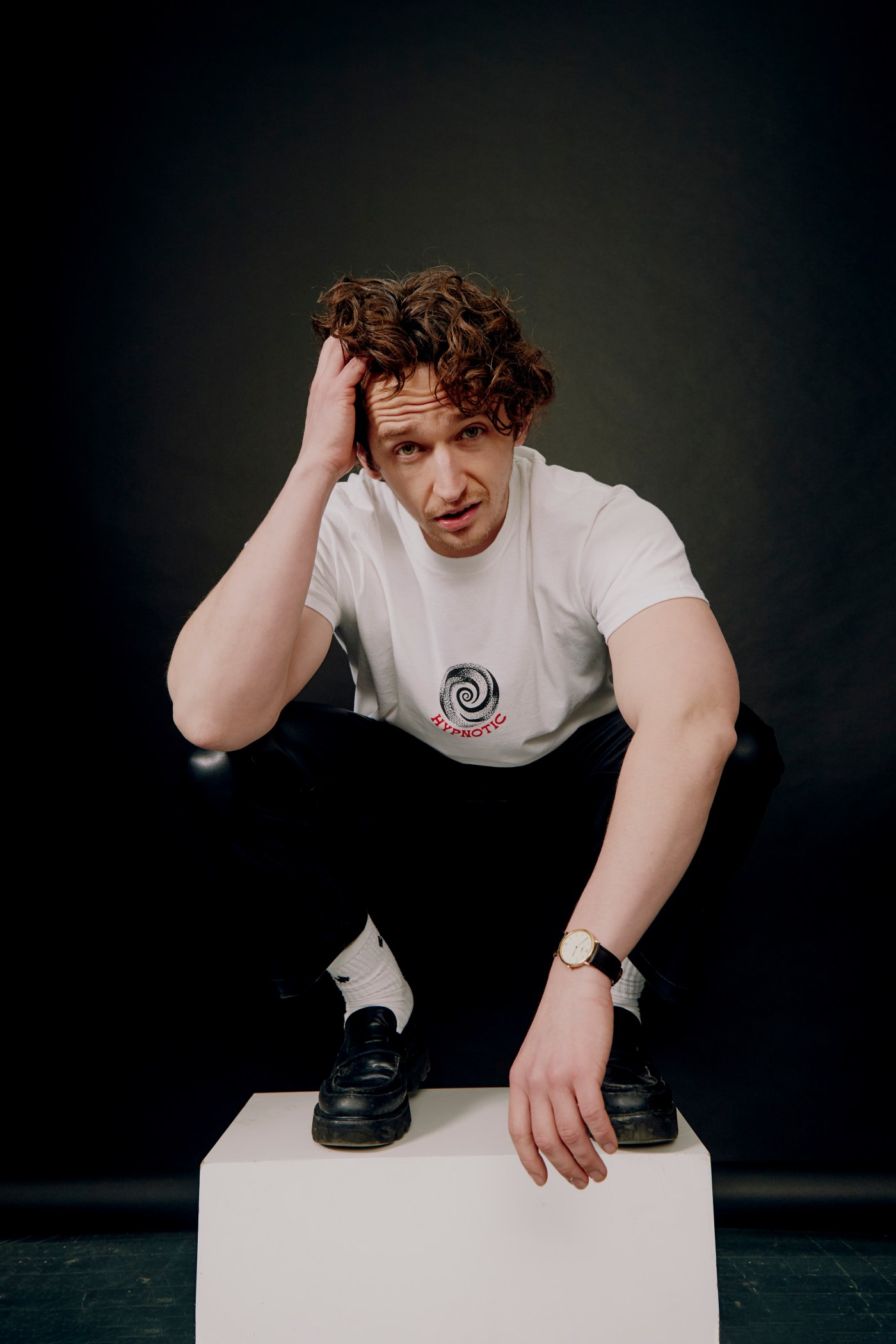
Critically acclaimed comedian, Milo Edwards – who was once referred to as ‘a bit like marmalade’ in a review- talks to Pepper&Salt about his bringing new stand-up hour ‘How Revolting! Sorry To Offend’ to the 2024 Edinburgh Fringe, how it is a microcosm of the arts in the UK, class, and the foundation of Britishness.
What’s the elevator pitch for your show?
The title How Revolting! Sorry to Offend refers to this one story about my girlfriend and I getting temporary tattoos on our arses at a comedy show and decided to send those pictures to her family group chat. The show itself – with that as a framing device- is mostly about class in Britain and how we relate to it. It’s a lot about my family and my grandmother specifically as an example.
What would you say is the most important question that you tackle during the show?
I guess the show at its core, is about social mobility in Britain, how we relate to one another, and how we relate to people who are moving up in the world or down in the world or vice versa. I take my grandmother as an example, having grown up in I think the most poverty that it’s possible to grow up in the UK and then versus where she’s ended up. I sort of advance this idea that my grandmother is motivated by spite and being motivated by spite gets a very bad rep, but it’s actually quite a good motivational force.
There’s something that I found interesting for a really long time that is unique to the UK, is the way in which every person has this immediate cultural and linguistic baggage. Every single person you meet if you’re British and you’re meeting another British person, immediately just by the things that they say and the way that they say them, how they look, sound and so on, you fit them into this kind of social hierarchy in your head. And everyone does this, whether they know they’re doing it or not, and it’s very interesting. It’s particularly fashionable at the moment to go around calling people posh or going like, “that guy’s posh” or whatever. I think people have such a bad understanding of who posh people are and what they’re up to versus people who seem superficially posh because they’re playing the game of society in order to succeed. The thesis that I advance in the show is that we actually like people who are genuine aristocrats, like the royal family, more than we do relatively ordinary people who are playing the game. And I try to speculate why that is.
How does this show fits with your previous work?
Carrying on from Voicemail and Sentimental, I think this show follows the same kind of school of political analysis of what’s going on in Britain. I talk a lot about what British culture has left, what it is actually like, what really symbolises Britain and Britishness as a culture in of itself versus how we think of it, and that’s something which has been common to a lot of my work. I’m obsessed with this country and the peculiar vibes that it produces. There’s something that I really notice about Britain is that there’s this sort of cast of washed up celebrities who just appear from time to time like Pokémon, they just crop up somewhere unexpected and you have to interact with them. I guess Australia is sort of like this, but it feels very British at its core. Then there’s a personal throughline as well. I’ve talked about my grandmother quite a bit in the previous show Sentimental as sort of a reference point for talking about my mother and I think my grandmother warrants more attention.
Taking onboard what you’ve explored in this hour and previous shows, in your opinion what is the overarching foundation or central tenet of Britishness that all other characteristics stem from?
The superficial aesthetic of Britain is so deeply rooted in mundanity. When people from abroad picture Britain they’re picturing Buckingham Palace or Tower Bridge. But what Britain really is, is a vape shop next to a betting shop on a high street which is next to a charity shop and a boarded up empty space somewhere in Reading. That’s what Britain really is if you want to capture it. It’s a guy who works in a CEX opposite a shop that says, “Everything is 10 pounds,” and makes no further explanation.
In a broader cultural sense, something that I like about Britain is there’s a sort of cultural obsession with fairness to an extent and with a certain modesty however false it may be. There are a lot of peculiarities that I try to tease out of British culture, but it’s quite hard and it’s a very shifting thing. I do think we get kind of high on our own supply with what we consider to be a British value or British culture. Britain is in a broader crisis in the sense of economically and socially everything is shit, but it’s also in a more specific identity crisis, which is shared with certain other places where it’s a country that used to be very powerful and important and it’s not anymore or not to the extent that it used to be and trying to figure out what the role of Britishness is on the global stage. I have a protracted bit in the show about the Falkland Islands, which is one of my other obsessions, because I think the Falkland Islands is such a great exemplar of what Britain is and what it does on the global stage.
Is there anything that audiences should be aware of before they come to your show?
A cursory understanding of the history of the Falklands Islands would be useful. Also, I think though that my style of comedy is I’m not necessarily a depth guy. I know a small amount about a lot of things and that’s what colours my comedy because I draw these reference points from all over the place, but then I’m not expecting a deep understanding of any of those things. My director did once say to me that “the person equipped to get everything in this show is you,” which is sort of a poison chalice as far as compliments go.
What is your favourite part of being a comedian?
When you write new material and it works, that’s great for me. My favourite thing to do as a comic has always been to write new material and so I don’t fine the churn of writing new stuff that difficult. Other than that, travelling. I love travelling, always have and so it’s a great way to do that for free, which is nice, especially to the great nation of Australia which I always enjoy. It’s like, what if Britain was good, you know?
Considering the title of your show, what in your opinion is the line between funny and offensive?
I’ve always felt as though there is a real difference between what I think you can consider intellectually speaking to be offensive versus what audiences will read as offensive. Most people are – in the least loaded sense of this term – triggered by certain words. Not triggered in an emotional sense, but certain words get a response out of them, and so they’ll hear what you’re talking about, and they will assess whether or not it’s likely to be offensive based on the subject matter at hand rather than what you are saying about it.
I think you can in theory make a joke about anything and not be offensive based on what you are saying about that thing. There are certain topics that I personally tend to stay away from because I just don’t think I’m probably the right person to make jokes about that topic. That’s the thing that a lot of comedians struggle with, what a joke is saying and what is the point; if you took the humour out of the joke, what is the actual point of view being conveyed by that joke. All of my jokes start from what I’m saying and then the joke comes from there, but I think a lot of comedians start with the joke and then a lot of the time they aren’t actually saying anything. So you can get yourself into sticky situations if you’re trying to defend a joke that you’ve written perfectly innocently because you don’t actually know what you’re saying. Whereas I always know what I’m saying so when people pull me up on “I don’t like this joke,” I’m like “well, if you break the joke down into steps this is what the joke says, do you disagree with that?” But 9 times out of 10, what they mean is, “you’ve made a joke about this thing which I don’t think is something you can joke about.”
This is your 4th year doing a solo show at the fringe. What advice do you wish you had received when you were making your debut?
How much the system of the Edinburgh Fringe does not function based on how good the show is and how you should probably invest a lot of time and energy into doing superficial things like PR and networking. That kind of stuff makes a lot more difference to how well your show does than how good your show is, but I think maybe also I was not ready to hear that when I was 26 and doing my debut show. Doing anything creative, it’s a bit like being a teenager in some ways, where every year you do something new and every year you kind of start to dislike what you did the previous year because the rate of change in your creative work is so high and so there is a tendency when you’re earlier in your career to feel as though you’ve reached a finished product stage, and I don’t think that’s the case. When you’re early in your career you can be similarly over and under confident in what you’re doing. Over confident in the sense of not feeling as though it needs improvement, but also under confident in the sense of when you look around, you’re doing stuff that’s worthy of a seat at the table, and it’s quite difficult to- it’s something I still struggle with a bit- to keep yourself on an even keel versus “yes this can be better and will be better.” Also, it’s competitive, it’s good, it’s not unworthy of being at the top table and I think that’s psychologically it’s a very difficult industry to be in.
How would you say the fringe and what it means to perform here changed since you started?
When I first went to the fringe, it was probably 2013 maybe, so quite a long time ago now, but I was only doing spots, and I think gradually over the years I ended up doing some mixed bill shows for a full run. I think I did the first one of those in 2014, and then I had a couple more years where I did spots and then I did more mixed bill shows and then I did the first solo in 2019 and every fringe that I’ve done since then I’ve done a solo show. Those early Fringes, I had a very different experience of because you’re not as involved. When you’re doing a mixed bill show for the full run you do get that sense of “we’ve got a show to sell every day” which I think is the overriding experience that you have at the Fringe, but it’s still like you’re doing it in that very kind of student-ey way where none of it really matters, it’s pretty chilled out, you’re just having fun. And then my more grown-up experience of the fringe is from 2019 onwards. And it’s palpable that it’s gotten more expensive, it’s gotten harder to do and it’s gotten much more in the loosest sense of the word commercial than it was, but I don’t think that change has been as dramatic in my career than it has say if you had been doing the Fringe in like 2001, you would probably feel that a lot more strongly.
It’s definitely reaching a kind of crisis point in terms of the cost of the accommodation; the numbers involved are ludicrous. I’m in a relatively fortunate position in that I’m with Monkey Barrel who are, I would say, the best venue to be with certainly from a financial standpoint and I think for me artistically they’re the best place to be. It’s not exactly a profitable month, but I’m not in the unfortunate position of losing a lot of money but you have to remember that a lot of people are in that position. I don’t know how it’s supposed to continue to function.
It’s very, very hard to make a living in the arts now and make it make sense. I am doing a show about class, and I think you know if you want more people and especially people from the working-class doing comedy it probably has to change a bit, but it’s difficult. Like everything in this country, it all just ends up in the pocket of private landlords, so what can you do.
Is performing at the Fringe worth it anymore?
Well, despite what I’ve just said, I actually really enjoy the Fringe. And I will say that probably is partly because I don’t have to worry hugely about the finances of it; I sell tickets, the venue that I have is great. I don’t incur the worst problems that some people have at the Fringe.
I think Pierre Novellie had a joke in his show two years ago where he was all, “I got into stand-up comedy to have no jobs not to have like ten jobs.” So much of the rest of your year is spent doing podcasts, marketing, anything that’s not stand-up comedy because those are the things you’ve got to spend your time doing in order to ultimately do stand-up comedy. The Fringe is this refreshing period where you’re actually immersed in stand-up for a month, and you feel like that is your primary thing that you’re doing and there are lots of other comics there and I think it’s great. I think of it like a trade fair where you go there, you see what everyone else is doing and that’s quite interesting, you develop a show, there is fun and comradery aside from the competitiveness and bitchiness of it.
Obviously, it has these fundamental big issues that it has to resolve, a lot of which is financial, but also, I think those are issue with which they’re not unique to the Fringe, there are a lot of issues they play out in Britain as a whole. I mean, yeah, it’s expensive to rent a room at the Edinburgh Fringe for a month and it’s more expensive than it should be but also, it’s fucking expensive to rent a room in London every month and that’s where you basically have to live if you want to be a stand-up comedian in the UK. I think sometimes people are a bit too dramatic about these problems with the Fringe, because these are problems, but they are problems which pertain to the entirety of the arts in the UK in general cause it’s not funded and doing it is very expensive.
In Shakespeare, the role of the fool and the king are very distinct, with the idea that a fool can’t be a king and a king can’t be a fool. How do you think this applies to the modern context?
I do talk about this in my show, the specifics of speaking truth to power. The thing is people who think they are speaking truth to power are crazy. You are at best speaking jokes to your audience and – like I said earlier – most stand-up comedy that I see isn’t really saying anything. And even if you are saying something, which I kind of try and do a bit, I don’t delude myself by thinking that you come away from my show being like, “wow what a message.” But I try to at least weave some ideas in there. You’re still only saying that to people who generally speaking agree with you.
There’s that old Kurt Vonnegut quote about the Vietnam War and how every single person in the creative industry was like a hate laser trained on that war for the entire time and it did absolutely nothing. A lot of journalists are like this too and are just convinced that they’re doing the Lord’s work or whatever. There are too many big structural forces that govern how the world works to convince yourself that through an incisive hour of stand-up comedy you’re going to make a huge difference. If you’re saying something that resonates with audiences or it makes them feel a bit better or helps them to articulate. I get that a lot from comedy audiences, people say to me “you articulated something for me that I had always felt about x y z” and I think that’s kind of the best you can do. If you do something and people find it funny, and they also find that it kind of helps them crystallize something that they think, then that’s basically as good as it gets, really.
By Katerina Partolina Schwartz
Photo credit: Joshua Peroti
 Pepper & Salt
Leave a comment