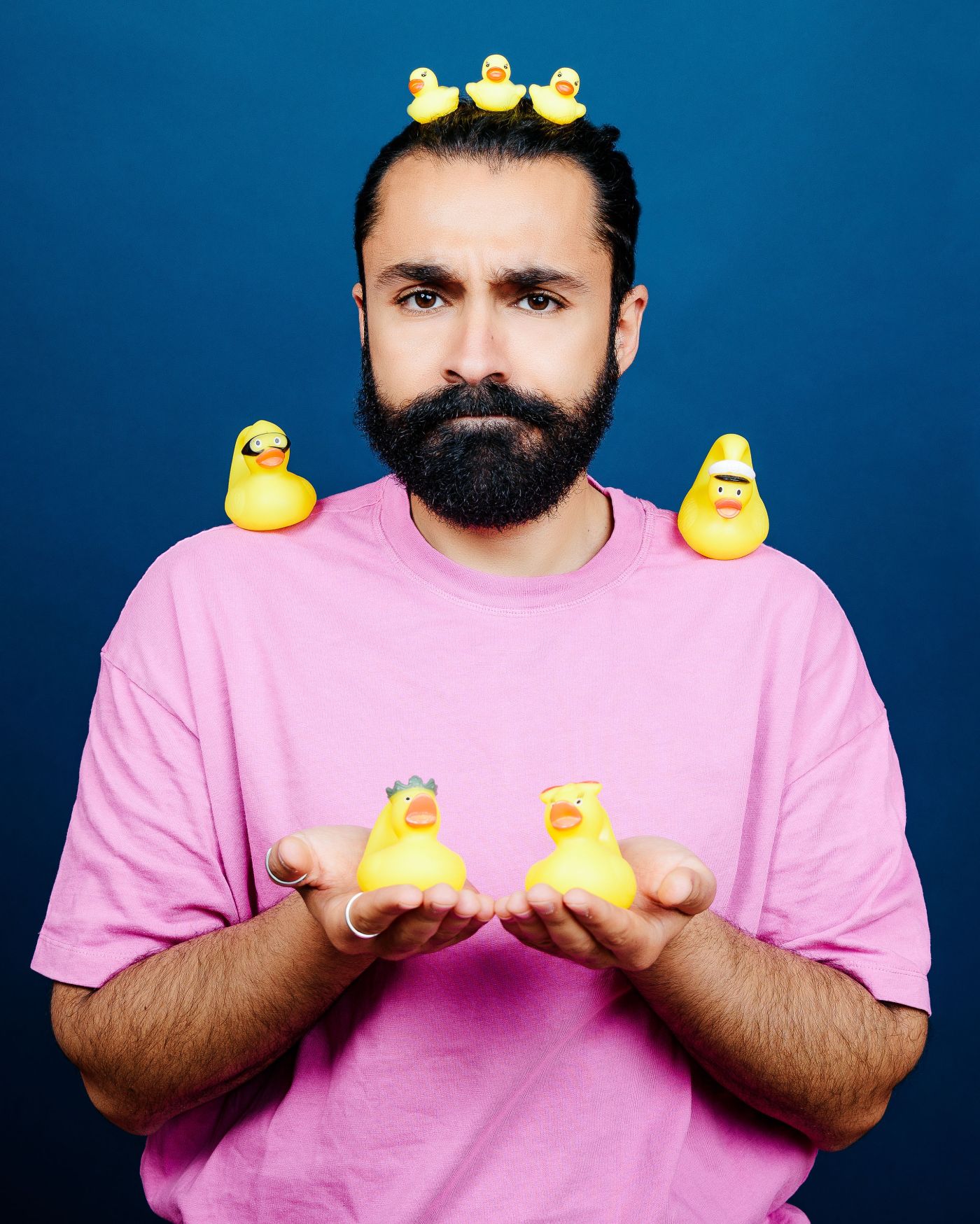
Debuting his new hour ‘Almost Legal Alien’ at the Edinburgh Fringe this August, Mustafa Algiyadi joins Pepper&Salt to discuss his show, his start in comedy through improv theatre, as well as touching on a few pertinent subjects of our time.
What do you hope audiences will take away from your show?
I hope that the jokes and the observations that I lay out that our differences are not as big as one might think, and we have a meeting point to laugh at things that touch between us and between different cultures.
How did you start doing stand-up?
I think I was looking for something for a very long time, but I wasn’t sure what that would be. Something to compliment the other side that I have, the scientific or whatever professional career. So, I was jumping from one thing to another in terms of hobbies, and one of the things that I landed with before starting stand-up comedy was doing improv theatre. Basically, I went by chance to watch a couple of shows, just as an audience member, and so the performers took my story and they came up with a whole 25-minute scene out of it, which I was completely taken aback by it because I’d never seen something like this, so I wanted to see more. Then by chance, I went to a jam session, and the performers told me, “Just join,” so I started doing improv theatre for a while. After performing a few times onstage to live audiences, it became very clear that my improv theatre performances were drawn in the direction of comedy, and somehow that was the segue. There was someone who pushed me, a friend of mine, and they told me, “You should try stand-up comedy,” and then I gave stand-up comedy a try. And I never looked back.
Would you say you prefer doing stand-up to improv, or are they non-comparable?
They are quite different, but I would stick with stand-up comedy. I like how holistic it is, usually you are the only one person onstage, and you need to navigate so many different components. But there are certain skills or things that I am using a lot from improv that I think are making my stand-up journey much easier as well as more enjoyable for audience members. So I riff a lot on crowd work interactions, I try to weave in comments or a random heckle every now and again through the actual material that I have, and I think this skill somehow has been developed in improve by thinking that, “It’s going to be okay, you can somehow let go of the control and trust the process, and just be relaxed.” And I think this came from improv. Every now and then I miss improv because it’s one of the rare activities where when you are actually performing it, you think very strongly to push away other thoughts and it is one of the activities that can very easily get you into flow. Whereas stand-up comedy, you are always thinking are the lights okay or about the sound, what about the people, the delivery of this joke. You are always thinking about these smaller things that are not seen, whereas with improv you should cast away all the other thoughts and just be in the moment, which is very nice to have every now and then.
In your professional opinion, how worried should we be about artificial intelligence in the arts?
I think it’s going to get into arts in a very strong way and it is happening at least with some of the more visually-based arts. There are lots of users of AI and people are fascinated by it. If we are speaking about stand-up comedy or improv, people are usually quite connected to the performer as well, so it’s not something that people would like to consume in a way that is disconnected from the actual performer, and this makes me feel like the art of performing live to audiences will still continue to be the way that it is. Maybe even we’ll have a reverse direction where people feel that they need to have more connection with people and live performances, but that said you cannot disregard what’s happening. Now, there are probably comedians who are using or relying on Chat GPT to get some punchlines, to add something, so maybe the assisting process will be weaved with AI a little bit.
In Shakespeare, the role of the fool and the king are very distinct, with the idea that a fool can’t be a king and a king can’t be a fool. How do you think this applies to the modern context?
I think the answer would depend a lot on how you define, “truth to power,” what do we mean by ‘power’ here or what do we mean by ‘the king’. Because I think each one could have a different definition of it. But if I were to project that question into freedom of expression and being censored as a comedian or not, as maybe one facet of this, then I think globally the situation is getting better for comedians. Obviously, there are dips every couple of years, maybe it’s getting worse, but the average is getting better. If you look at, I don’t know, 40,50 years ago, what an average comedian could have said onstage in comparison to now, then you definitely have more freedom. That said, there are many trends that are happening, and they might curtail what you are allowed to say and not allowed to say or how you say them.
Many comedians, from my perspective, they make the statement that, “Oh you cannot talk about this topic, you cannot talk about the other topic, because that’s woke culture, it’s spreading, and not allowing people or comedians to express themselves.” I don’t really agree. I think it’s about how you say it, because comedy is not an art form that you think about solo and then you just project it and each would perceive it in their own way. Part of the process that you are doing is performing, it and the joke is basically existing in the context of the audience that you have, so if the audience is not giving you positive feedback, then of course your job is to try it on a different audience, you try it over time, you try to change the words. If it’s not working, it’s not because you are not allowed to speak about certain things, but maybe you are not doing the right formulation. And many topics that have been over-killed and people say, “Oh this is something that you shouldn’t be talking about because it’s over,” you can always find comedian who manages to find a new angle that makes it all new, that brings a new perspective to it. So, it matters a lot how you mention things. It matters a lot as well, I think nowadays who you are, which I think is something new to probably 50 years ago; there are associations about your background, and who you are that allows you to say certain things versus other things, so this is one of the changes that we probably see now. That said, there are still some things that could be tricky, but not maybe how the audiences react to you. So, as an example on the 6th of October, there was advertisement on Instagram about an Israeli restaurant here in Munich, and I just wrote, “Ah yeah, I love Palestinian food,” as a joke obviously. I got so many reactions to it, but that was the 6th of October, and then the attack of the 7th of October happened, and I received on the 8th of October a threat via email that ‘people like me are not welcome any more in Europe and I should watch myself, things could happen to me.’ I thought it was just a random email. Then, I had two shows booked in Switzerland and they had received threats that they shouldn’t have me on because of my ‘radical Islamist views’ and so on, and they would get into trouble. The shows have been cancelled actually because the venues actually feared that something might happen to them. There are certain things that are still al little bit tricky, that you can navigate, but this is again, depends on the point of time that is happening or whatever you are saying, but I think the average overall is improving.
 Pepper & Salt
Leave a comment