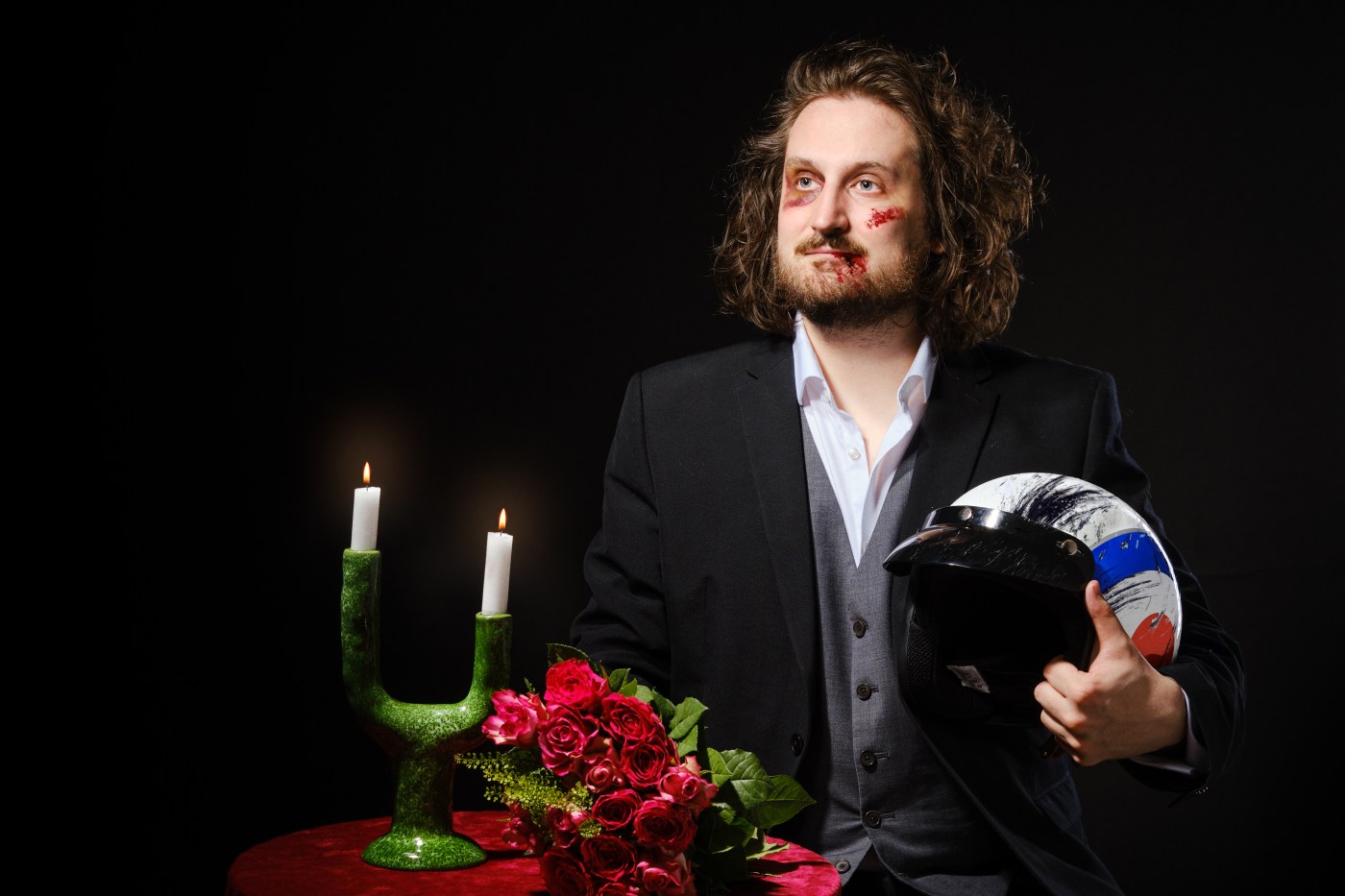
Self-described sentimental cynic Alexander Bennet sits down with Pepper&Salt to discuss his new Edinburgh Fringe show, Emotional Daredevil, manages to find the way to do so without giving away any spoilers whilst still providing insight into its potentially collaborative nature.
What is the elevator pitch for your show?
The elevator pitch for Alexander Bennett: Emotional Daredevil is it’s a show about risk and the benefit of taking risks, and I am taking risks in the show and with the audience in a unique way.
What are the risks that you’re taking?
See, this is difficult, because there’s a certain amount about this show that I need to not tell people before they come in for it to work. I suppose a broad thing is, if you saw my last show, this is a very different beast. It’s still me and my comedy if that’s something that people enjoy, but if they’re more familiar with me from the last show, then this is a very different thing.
What ideas are you exploring in your show?
The idea of risk-reward on a personal level. Like business leaders will talk about, “Spend money to make money,” and, “You gotta speculate to accumulate,” and all that sort of thing. And I think that risk is a necessary factor in building meaningful relationships with people and in living an authentic life. And you have to take some personal risks in your personal life in order for your personal life to be fulfilled. That’s a very straight forward non-funny answer to the question.
What was the writing process like for this show?
I had the idea how the show was going to function. The writing process for this show has been a lot more collaborative because there have been more people involved in making things for the show than just myself and that will continue to be true as the show is put on. I’ve really enjoyed it, it’s really nice to work with people to make something, but also time-pressure is a factor. I’ve just had a good and busy year, but it means that it absorbs an awful lot of your time and takes time away from the, “Oh right, the Edinburgh show.” And I’ve got stuff, but I could see that August is hurtling towards me and I can see how much work there is left to be done, so I’m in a good place but also terrified.
How much preparation are you able to do if the show can differentiate so easily from one performance to the next?
Quite a lot because the bulk of the show is still me exploring the ideas that I want to explore, and it’s just in the form of a kind of persuasion in the show. So, it’s directed at some people, someone, something, but there is still a large amount of the show that is me going through ideas that I want. So, the challenge for me is to blend that with the participation stuff so that it feels like all things have equal balance within the show. It’s very specifically collaborative.
You mentioned previously that this hour is completely different from last year’s. How did you find that pivot?
So, I’ve spent quite a few years in my solo work doing like very straight stand-up shows because I love very straight stand-up. It’s not actually where I come from as a comedian; I started as a character act and I’ve done lots of things with like Consignia, the kind of anti-comedy, weird group thing. I did a game show, my podcast is very different to my stand-up, trying to collaborate with different more interactive comedy shows over the years. So, for me it feels like more of a return to something I started with, but with this whole extra skillset now, if that makes any kind of sense. And applying that in a focused way; you know you can be a jack of all trades in your skillset so long as you’ve got a focused thing that you’re trying to achieve with it, and that’s sort of what I feel I’ve got now.
How much audience participation would you say there is?
I would say that a lot or possibly none is my cryptic answer to that question.
What kind of a dialectic do you hope to create with the audience?
The content of the show is quite specifically a dialectic. I’m trying to make it something that’s actually personally useful to people, so I hope that – because there is audience involvement in my show – what I’ve tried to do is make something that people will leave going, “I’m really glad that I was involved in that.” So, a constructive dialectic, I hope.
Favourite part of being a comedian?
My favourite part of being a comedian is that I get to prioritise being creative in a way that very few other people get the opportunity to do so. So, it’s an incredible privilege really. There’s like an artsy answer to that question and a kind of more swaggering performance answer. The artsy answer is the one I’ve just given; to make things that I really care about and present them to people. And the other thing is I can walk in front of a room full of 200 people on a Saturday night and completely control them. I want to say it’s like sport and art.
What is a piece of advice that you wish you knew before making your fringe debut?
Honestly and it’s sort of sad to say this. I did my first show at the Fringe when I was 21, many, many years ago and unfortunately, I wish somebody had just taken me aside and said, “Look this is how the industry works. You need to be – if you want to have a career – you need to be debuting in a paid venue with PR and all these sorts of things.” And it is unfortunate that that is the case because the reason I didn’t do those things then is because I didn’t have the money. There’s a huge financial barrier for people trying to do the Fringe and as long as that remains, the less diverse talent is going to come through and the people who are going to suffer the most are people from working class backgrounds – of which I am one despite my entire vibe – and I wish someone had just put a hand on my shoulder and said, “Look, maybe wait a bit and have certain things in place so that when you debut, people see it and consider you in a certain way that they don’t if you just start doing shows on the Free Fringe.” I love the Free Fringe, it gave me years of being experimental and trying things and meeting people and I loved it, but career-wise, unfortunately you need to buy a ticket. So that’s what I would tell a young person and I have told that to people who are about to debut, I’ve said, “Look, the industry works in a particular way, and you need to get onboard with that unless you have a better idea.”
What are you looking forward to the most at the Fringe this year?
I am looking forward to being at the Festival, because once you’re there, you really do get to wallow in the fact that you’re around lots of brilliantly creative people who are trying their very best to make something happen. And I love that, I didn’t realise how much I’d miss when I hadn’t been at the Fringe for a couple of years post-pandemic. So that’s the thing I’m most looking forward to is wallowing in the fact I’m in a hub of creativity and doing things with other people. I’m gonna make the same promise everyone makes themselves every year when they’re a performer which is, ‘I promise that I’m going to see more shows,’ and I’m going to singularly fail to do that. But I’m definitely going to get involved in more stuff where I can, and that often takes the form of being part of someone else’s show and that’s really great.
What do you think about how big the Fringe has become?
I don’t think that necessarily the Fringe being too big is one of the issues with the Fringe; I think that the opportunities need to be spread out further, rather than the Fringe contracting. I think that a lot of the opportunities that people get or have access to seem to come from very narrow set of factors, so I think that rather than contracting, if the reasons people go to the Fringe was sort of more evenly spread out, then that would solve a lot of issues. But the main issue is just how expensive it is to do, and I don’t know if the Fringe getting smaller necessarily makes it less expensive. Maybe it would, I don’t know.
Just a sort of a general sort of thing that I think would be a good idea to communicate to potential audiences- and this has been consistent since the pandemic – fewer and fewer people buy tickets to things in advance and I just think it’s worth putting out there that it’s really helpful to buy tickets in advance for things, for all sorts of reasons. So, if you’re thinking of going to see someone at the Edinburgh Fringe, buy a ticket in advance, cause it’ll really help.
Apart from your own hour, what show would you recommend?
Well, I haven’t had much time to look at exactly what’s going to the Fringe this year. There’s lots of really great people. Off the top of my head, I know Ania Magliano is back; I’ve only got familiar with Ania recently and she’s always doing something interesting. John Luke Roberts is doing like 10 Edinburgh shows back-to-back at the Fringe, and if you’ve missed some of those, particularly Stnand Up and Stdad-Up, they are some of the best shows I’ve seen in Edinburgh, so they are definitely worth a look. If you can find Mark Dean Quinn, go and see Mark Dean Quinn. Yeah, lots to recommend, I haven’t had much of a chance to look at the full brochure.
In Shakespeare, the role of the fool and the king are very distinct, with the idea that a fool can’t be a king and a king can’t be a fool. How do you think this applies to the modern context?
This is something that I do think about, because I think it is interesting that basically in all cultures, the role of a fool is a thing that kind of naturally develops. And you could see that in more Western cultures going way, way back, you see it in cultures all over the world, you see it in tribal cultures, and various different things. The fool is a kind of thing that naturally occurs and I think that’s because it performs a function within a society and that function is to kind of play with logic and play with emotions in a way that allows for some kind of release, and I think that when thing start to break down in society – as I would argue they have in more recent years – that’s when the role of the king and the role of the fool gets messily overlapping. And I think that you only really have to look at how politicians and comedians have behaved over the last decade or so to see that there is an unhealthy bleed between the positions that some comedians think that they should hold, and the casual and irreverent way important people hold their positions of authority. I think that’s a result of the social contract breaking down.
By Katerina Partolina Schwartz
Photo Credit: Ollie Craig
 Pepper & Salt
Leave a comment