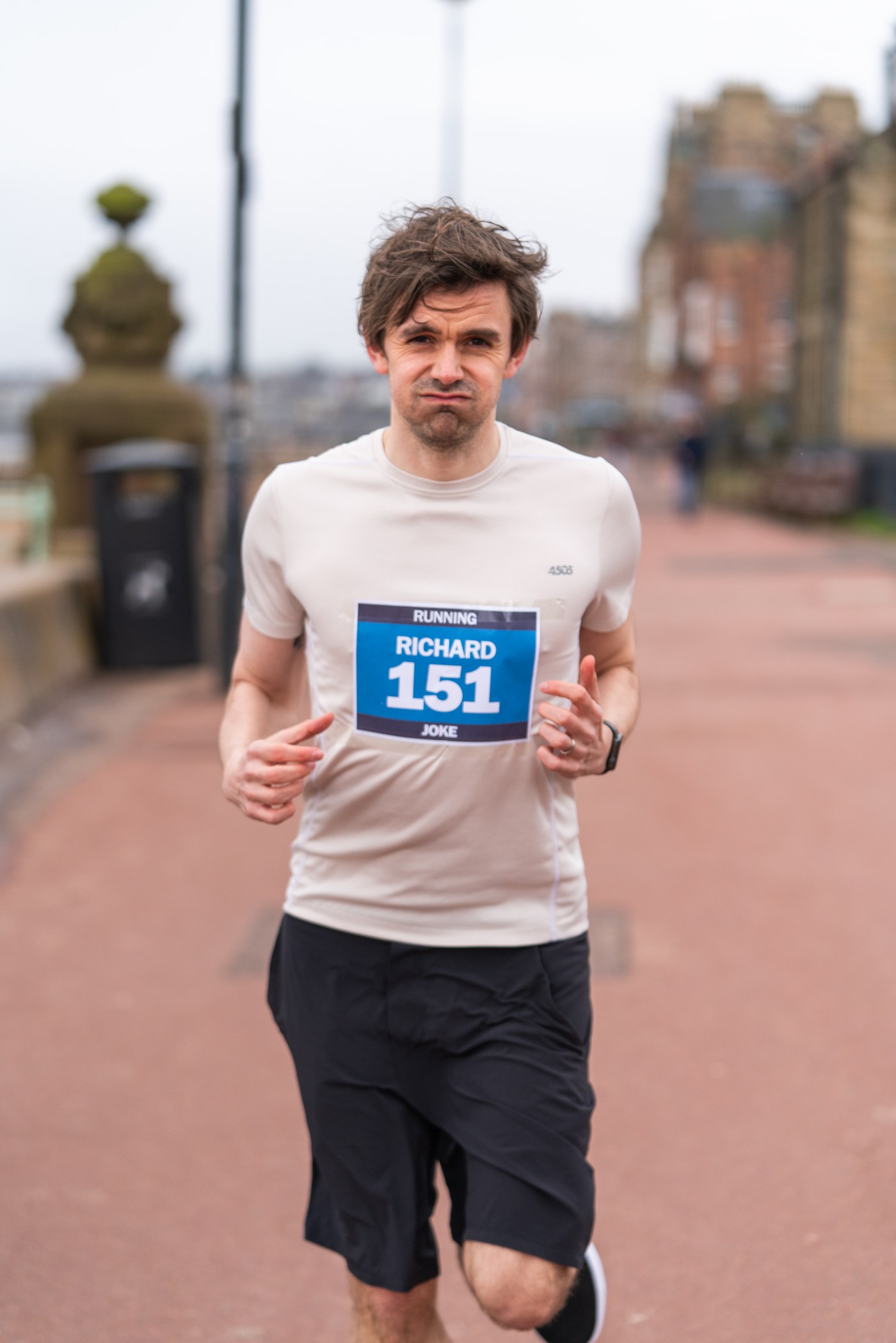
Back at the Fringe for a second time, Richard Cobb talks to Pepper&Salt about the sequel to his Fringe debut – Running Joke – his foray into the Edinburgh Marathon and how he created The List.
How would you summarise your show?
I guess it’s sort of autobiographical, about running the Edinburgh Marathon in 2023 and is really just about my competitive nature coupled with insecurity So, it’s really about setting myself challenges, and sort of wanting to be competitive and part of my brain being competitive, but then at the other side being insecure, so not wanting to finish last. The race sort of summarises the opposite ends of the spectrum there. And it’s a continuation on last year’s show; it’s a lot of trying to find the resolve, but then the race gets in the way. So going through a lot of emotions throughout it.
What was the initial reasoning behind setting yourself these challenges?
I lived in Australia for a little while into 2016, and I think it really started when my wife had a job over there, so for like two weeks I was trying to busy myself and find things to do, so I started kind of writing and then I set myself a challenge to write a couple of books essentially. I do my best work when I’m stressed, so a lot of it came from initially writing this stuff and then wanting to do stand-up off of the back of these stories. At the tail end of October 2022, I got married; we’d been engaged for 4 years and I felt that it was 4 years of planning and then after that I immediately wanted to dive into planning something else and setting myself goals and challenges. Really it was just a variety of things really from facing fears to wanting to run the marathon. Maybe subconsciously to write about in the future, I’m not sure.
How did you create the list?
To be honest, I think that it just came around on the basis of whatever ideas I had in my head. It started on the plane back home from my honeymoon in October 2022, I just got the idea that part of the honeymoon could form part of my first debut hour of stand-up, so I wrote it on the plane really without an idea of where it would go, and I realised afterwards that I might as well put my first hour on with only having done 10 or 15 minutes of stand-up before. Again, I thought it was a challenge that if I put that on at the end of the year -in two months’ time – maybe I’ll stress myself for it. It’s easy to put things off and I feel that if I put a date on something then I have to do it one way or another, so I worked really hard to make it as good as it can be. With the marathon and things like that, it was probably just after New Year’s and I realised that I had had one or too many beers over New Year and Christmas and unhealthy food. Ot was that usual, “I’ll get fit in January, this will be great.” I noticed the entries had opened for the Edinburgh Marathon, and I thought, “I’ll just sign up for the Edinburgh Marathon, then I’ve got 5 months to get fit,” so again it was very much putting a deadline on things and thinking, “I’ll worry about it later,” but also realising unless I put a date on something I probably won’t achieve it.
Is there anything that you didn’t complete or was too far outside your comfort zone?
Well, I got a tattoo last summer and then a bit of the ink fell out and I keep thinking I need to go back and get it filled in, but it was painful and I keep making excuses to not get it filled in. So, I’ve sort of got three-quarters of a tattoo at the moment. I think one day I’ll go back, but again the pain I went through, I was a bit like, “I don’t know if I can go back,” but yeah I guess there’s that. I think more so I do the challenges but it’s a kind of think afterwards that maybe it’s not a great result, so in terms of the marathon; I completed it but then afterwards I thought I’d have satisfaction, but then I thought I could’ve done it better, and maybe the same with last year’s Fringe show. I thought it went well to a degree but then what could I have done differently, could I have done better, so I think it’s not necessarily about doing the challenge for me it’s more, “Could I have done it differently?” So that’s what I’ve tried to work out in this show as to, “What am I aiming for?” That kind of how I can have the perfect situation?
What do you hope audiences will take away from this show?
Whether it be writing essays or writing stuff in a book I kind of want to say relatable things that are just everyday struggles. Last year was about battling staying present in the moment; that was last year’s show, Couple’s Massage, and it was about being present and trying to be less nostalgic/ I kept thinking back and thinking through rose-tinted glasses like “That was great and everything worked really well,” but then you realised at the time that you were looking further back and thinking, “Oh if that had gone well,” but I think a lot of it is trying to remain present . This year it’s trying to be a bit kinder to yourself, and I think a lot of us have that kind of self-sabotage, and securities and I think ultimately, it’s trying to show at the end that it doesn’t matter where you are compared to others, like you know we’re all doing our own sort of race I guess at the end of the day. So, I think we should be kinder to ourselves is kind of the main message.
What is something that you learned from doing your Fringe debut last year that you’ll take on board this year?
I wasn’t very confident with the show itself to begin with. It was like the week before Fringe when I started sending it out to reviewers, which is not a good idea. I didn’t think it would be ready so I wasn’t overly comfortable with that many people coming to see it, which again is counterproductive but then I felt as the show grew then I was like, “Actually it’s getting better and I am more comfortable with that,” but I’m obviously too late with deadlines. This year I approached it differently that I would do more behind the scenes to try and promote it. I was not good at flyering either or bigging myself or the show up, so I realised that if I’m wanting to perform to anybody and if I’m wanting more people to come to it then I need to believe more in what I’m doing, and the more I did last year’s show, the more I realised I am capable of doing it. I think from that point of view it was helpful. I learned as well I think that doing the show every day that I used to be quite bad at dwelling over a bad show, so if it had gone badly the night before I’d maybe overthink it or if the show had gone well the night before I’d think for a week, “Oh that went really well,” whereas I guess the disposable nature of the Fringe just helped it; one night it was a good show, forget about it the next day or if it was a bad show, forget about it for the next day. So, it was a case of just treating everyone as an individual.
Apart from your own show, what other recommendations do you have?
Rosalie Minnitt has a show- Clementine– she was up in Edinburgh last year and it got really great reviews, and I think unfortunately we’ve got a clash but she’s on at Underbelly. I think she’s doing a shorter run this year and just from clips online it seems to be going really well. Rich Spalding’s a really good comedian, he’s got his debut hour at the Pleasance. Mark Nelson’s a Scottish comedian, he’s got another show that he’s doing I think at Monkey Barrel this year. I went to Christopher Macarthur-Boyd earlier this week, and he had a show called Scary Times. And Liam Whithnail is doing a show called Chronic Boom, which was the best show I saw last year in Edinburgh, so he’s got that over a couple of dates as well.
In Shakespeare, the role of the fool and the king are very distinct, with the idea that a fool can’t be a king and a king can’t be a fool. How do you think this applies to the modern context?
I think it’s that balance; so for comedians starting off, it’s like their voice doesn’t matter and they get shot down quite a lot one social media, whereas I think that when you get to a bigger comedian I guess arena filling comedian, I think, the issue is if you start going backwards and people compare and say, “You weren’t talking about that in your early days, why does it suddenly matter now?” it’s a difficult one to balance, I really think it’s realising that people can change and ideas and opinions can change. There’s no set way in that people can interpret things or people, everyone is going to have an opinion on you or what a certain person says. I think there is no hope that everyone’s going to be universal about an individual or comedy style or what you can and can’t say. And maybe it’s what keeps it newsworthy. It’s that whole thing if it’s worth to not be talked about than to be talked about.
By Katerina Partolina Schwartz
Photo Credit: John Mackie
 Pepper & Salt
Leave a comment