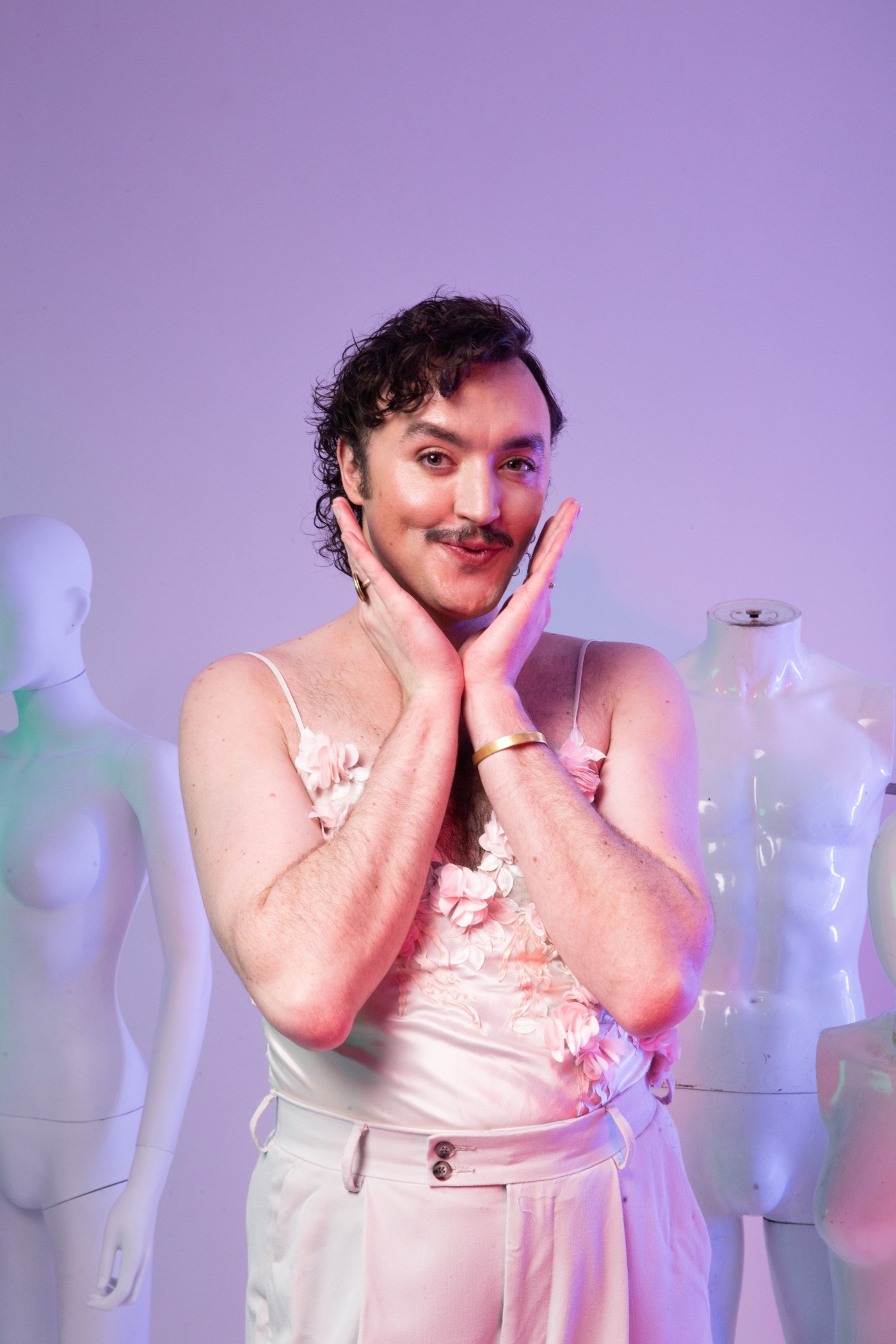
Debuting this August, Dan Wye brings their stand-up show, Dan Wye Am I Sam Smith, to the Edinburgh Fringe about the absurd and intense reality of being mistaken for a 4-time Brit Award Winner. Here they chat to Pepper&Salt about their debut hour, their work as a multi-disciplinary artist and Séayoncé.
What are some of the themes or central narratives that you explore in your show?
In the show, I explore what it was like, this journey of people thinking I was Sam Smith. I also explore just queer identity, what it means to be a ‘good gay,’ what we’re brought up thinking is a gay person, how much of that is our own thoughts and what we observe from society. A big thing of it is looking at intimacy, like I really want to be able to portray queer intimacy on a stage in front of people who maybe aren’t my community. I don’t want to dilute myself, I want to be able to present a layered person, an intricate person, like a fully formed person instead of maybe just like a stereotype. I have that pressure to present something that people think it should be. Another part of it is like, I once got told well, by my therapist that my brand was being tragic and iconic simultaneously at all times. A lot of that is me exploring, doing things that happened to me in my life that are tragic but also iconic, like even the doppelgänger thing is like iconic, sure, that people think that you’re a celebrity, but then like the point where you start to get agoraphobic about it because you can’t leave the house without people harassing you becomes more tragic. So just like a camp show looking at the deep, dark places of the queer world.
You’ve done a lot of work within other genres apart from stand-up, so how did you start doing comedy?
Well, my friend actually tricked me into comedy, I was kind of acting beforehand and my friend said, “Oh I think you’ll be a good comedian,” and I obviously thought she was saying I was a bad actor. And then she was doing a fundraiser for a theatre show she was making and the day before she was like, “You ‘re on the bill, I put your name on the poster. You have to do 10 minutes tomorrow.” And I did that, and I really enjoyed it. I was kind of doing stand-up for the past few years on the circuit, then I created the comedy drag character that I do as well called Séayoncé; it’s like a comedy mystic, like a comedy ghost-whisperer. And that basically derived from the fact that I was MC-ing this night in Soho and this man had ghosted me, so then I was just chatting to the audience, and I was like, “Oh, he must be dead, so that’s why he’s not texted me back. We have to contact him from the afterlife.” And I was like, “I can’t be Dan, I have to be a higher being, the Queen of the Afterlife, maybe like… Séayoncé?” And I thought it was a really good idea and I decided to create a character with Soho Theatre and other comedy cabaret people. I started doing that character quite a lot and touring that around the world and things. I’ve kind of come back to comedy because that is a ceiling; if you’re a comedy drag character, I think it can be quite difficult I think for people to see beyond that fact that you’re in make-up and that you are a comedy act and not just like a drag queen. So, I kind of wanted to go back to Dan just to make it more refreshing for me, and also to I don’t know I guess I found myself at the ceiling with Séayoncé and I wanted to explore different avenues.
What are you looking forward to about your debut at the Edinburgh fringe?
I think in equal measure I’m looking forward to but also think I’m terrified of is presenting myself without the mask of a character. I’ve done Edinburgh maybe three times as Séayoncé, and especially developing the show, I’m realising more and more how much more vulnerable it is to present yourself than a fully make-uped, fully dragged being. I’m excited to connect with people as myself, that’s also a thing absolutely terrifying me. I guess also just being around the other comedians is like, although it is hell, it’s also a really nice time for you to kind of like be with your friends and your colleagues, and to see things that are inspiring. I also try to really boil it down to the points of why I do this, I kind of went into comedy because I watched other comedians and was inspired by that. I got tricked into it because I enjoy making people laugh, and I think to try and take expectations out of it and to be like, “I’m there to make people laugh, and to laugh myself and we always try and promote queer joy in what we do, whether that’s Dan or Séayoncé.” It’s really important for that to come across, cause I think that is the way of connecting with people to who aren’t necessarily from your community to promote queer joy. I’m excited to tell this story. It’s one of those things where I really process a lot of the questions I have with things that maybe made me insecure or things that I haven’t necessarily got the answers to, and I find the stage a great space for that. When I first started stand-up, I was just fresh out of the closet and I could barely say that I was gay in a room, and stand-up made me stand onstage and be like, “I’m a gay person,” and get a positive reaction to my experience, and then drag elevated that even more. And I think these questions I’ve been having from this experience, I’m excited to put that out onstage and figure things out for myself.
In Shakespeare, the role of the fool and the king are very distinct, with the idea that a fool can’t be a king and a king can’t be a fool. How do you think this applies to the modern context?
I think it’s interesting, the role of the king and the fool in terms of status. The role of the fool is contrasting status, you can either be the person taking the mick out of the elite or you’re the punching bag for the elite. You know, there’s a mixture in status. Whereas a king’s status has to be high status all the time, whilst the role of a fool is changing. I think we’re seeing at the moment that not being true, I think we’re seeing at the moment that a lot of the people who are kings or people who are in power, are fools. There’s like a weird Machiavellian clown situation happening where these people are making such obvious mistakes and being foolish. Especially the role of the internet in taking them down, there’s so many memes and tweets and things that are highlighting the mistakes these people are doing, cause they seem to not know what their roles are. So, I think in the modern-day context is different. Even if you look at certain politicians, a lot of their brand is being a fool like it’s almost like this subversion of being, “Oh no, I’m just this blubbering fool, don’t take what I do seriously, this is an act,” and actually that’s a thing to distract you. I think at the moment, what we’re seeing is a lot of our leaders, a lot of the kings being fools and that kind of being a big part of it. Especially with the Internet, there’s not much distance with their private lives or who they are, cause we can see all the information constantly and we’re seeing actually that they don’t hold this high status all the time, and that maybe they’re tact is using the status of the fool to do more, to permeate further.
By Katerina Partolina Schwartz
Photo Credit: Dylan Woodley
 Pepper & Salt
Leave a comment