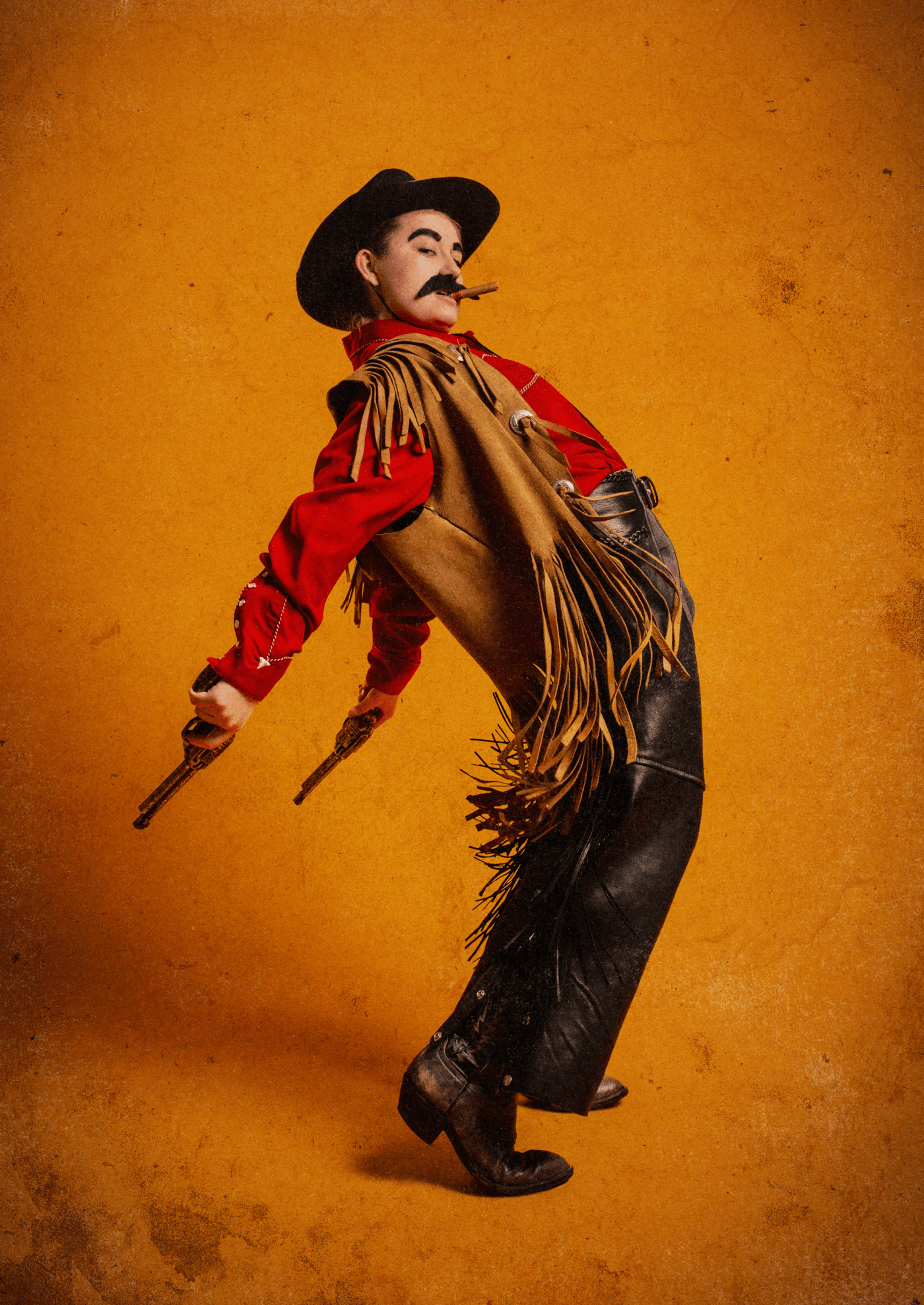
Saddling up to make her debut this year, Lil Wenker gives Pepper&Salt some insight into her new clown comedy, BANGTAIL, Alan himself and her clowning journey to the Edinburgh Fringe.
How would you summarise this show?
BANGTAIL is a clown western about a cowboy-turned-accountant searching for his purpose. It follows a pretty simple narrative—a man trying to find his purpose in life—which is told through a series of physical games and audience interactions. We started making the show with the inspiration of a cowboy in the American office space, loosely inspired by my father, an accountant from Minnesota who loves cowboys.
Is there anything in particular that you explore in this show? Primarily, BANGTAIL is a show about masculinity. I have been so fortunate to pursue an “alternative” career path, and so many people are not provided the same opportunity. However, I have specifically reflected my decision to be a comedian when considering my relationship with my dad. My dad is an extremely creative man who has an extremely un-creative job (accounting at an animal feed company). And with his job, he is able to access things he values far more than creativity: the ability to provide, stability, structure, a purpose, a clear path. In the show, I consider how this sort of expectation shapes men for good and for bad.
Can you tell me a little bit about Alan. What is he like, how did this character come about?
Alan is a comedic rendering of my father, Alan. He’s an extremely soft and sensitive man who wants to be the tough-guy-hero. It’s a little like Don Quixote: he’s an absolute idiot but he never stops aspiring to greatness.
The Wild West and the American office are two very stark contrasts. If it’s not too much of a spoiler, what does that journey look like’ why those two locations?
Oh tricky! Well I don’t want to give anything away but we thought a lot about how a man at the top of his field (the baddest cowboy or baddest accountant) can “get got.” How does this man go from being on top of the world to identity-less in an instant? And once this kind of man, who relies so heavily on his “label,” loses his status, what does he do?
How did you come to the realisation that that you wanted to do clown comedy?
When I was 19, I went to fringe for the first time to flyer for Baby Wants Candy. I got to see loads of shows, and I took the chance to see as many genres as possible. At this festival, I saw my first clown cabaret (now the very famous Stamptown). I had never seen that kind of comedy before, and I was fascinated by the amount of fun the performers could have while doing … basically nothing. During the pandemic, I deferred a year of uni to attend Gaulier in France, where I took my first course in clowning. And from then on, I’ve known I wanted to work as an artist.
I went to Gaulier when I was 20, and most of my classmates were at least several years older than me and far more experienced. This experience really shaped my desire to perform because I saw so many examples of working artists doing this lifestyle in so many different ways. It showed me that if I want to do this I can find a way.
How did you start doing clowning?
I really threw myself in the deep end when I went to Gaulier. Up until then, I had done a lot of acting classes and participated in my uni’s sketch group, but I had always avoided improv at all costs and had extremely little exposure to clowning. And I was … EXTREMLY unfunny for the vast majority of my time at Gaulier. I had never been on stage by myself before and felt extremely shy. I feel I’ve only begun to learn clowning in earnest by creating BANGTAIL.
What has your experience of clown comedy been like in the UK?
I moved to London specifically to pursue a career in clowning, and I genuinely believe that this was one of the most important decisions of my career. The big difference I feel in the US vs the UK is the sheer volume of people interested in alternative comedy—performers and audience members. I have been able to develop an entire solo show in a year because there are so many places to try out my material and so many people willing to listen and give me feedback. I believe it’s why we can have such a big festival like Ed Fringe run for so long and at such a massive scale. People are hungry for weird, and that’s exactly what I’m serving up.
What are you looking forward to about your Fringe debut?
I’m just excited to get to do the show everyday for a month with keen audience members. What a gift—one that does not come often. I have learned so much about the show and this guy I play and performing in general from practicing in front of an audience, and fringe provides me the best opportunity to do just this.
By Katerina Partolina Schwartz
Photo Credit: Hudson Hughes
 Pepper & Salt
Leave a comment