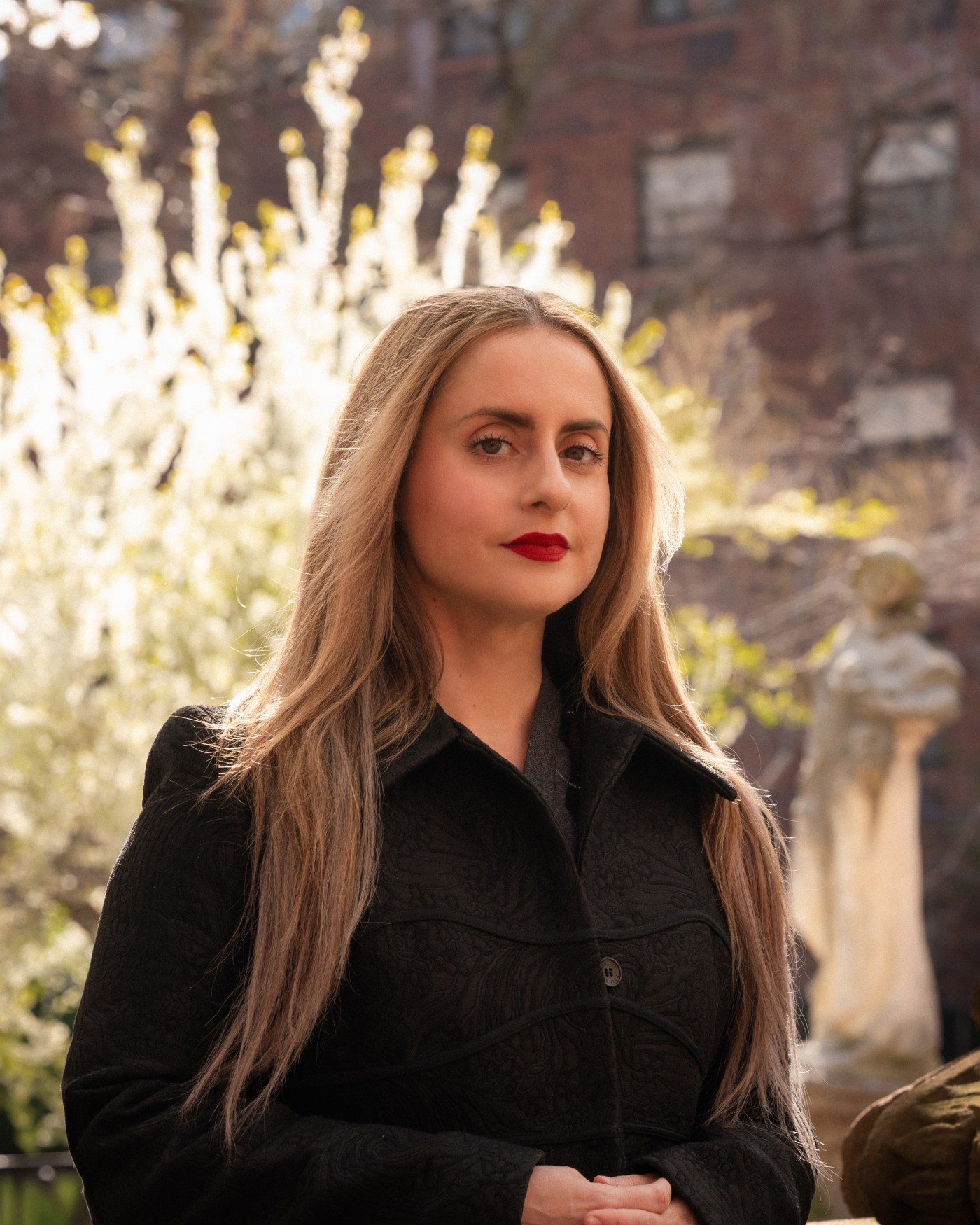
Democratic nominee candidate and comedian Corinne Fisher discusses her run for the role of a lifetime – New York City Mayor – with Pepper&Salt. In this interview, Fisher dives into her candidacy to be the Democratic nominee, her leadership experience and thoughts on the political nature of art in the current climate.
What inspired you to join the mayoral race?
Before the presidential election last year, I had been trying to encourage listeners of my political podcast to run for office on a municipal or national level. Specifically, I wanted any of the younger women in my audience to run. I offered my support whether by donating money or lending them my platform with access to hundreds of thousands of people, but no one felt ready to step up to the plate. So I made a declaration that I would be running for public office if Donald Trump won the presidential election in November. He did, and here I am. We can’t keep making empty threats as Democrats, I didn’t want to be a part of that narrative of being ineffective.
If you were only able to do one thing whilst in office, what would it be?
Get the over 100,000 New Yorkers experiencing homelessness into affordable units. We are in a housing crisis and we need to start acting like it.
What do you think is the most important policy, change or consideration for New Yorkers this cycle?
Not to elect a criminal in cahoots with Donald Trump who is only running to buy himself a get out of jail free card (hint: this sentence could be about two of the candidates).
As a grassroots candidate, what are some of the obstacles that you are facing and are they the same for every candidate seeking the Democratic nomination?
As a grassroots candidate I get all the obstacles every candidate faces plus more, the biggest right now being access breaking through to journalists. People barely pay attention to municipal politics as it is, which is why it’s the perfect recipe for corruption, but local political journalists really have so much power in this race. They are the gatekeepers deciding which candidates you hear about and which ones you don’t. And one journalist told me quite frankly that they are taught as political journalists to simply “follow the money” so it’s pretty easy to see why we’re in the position we’re in. We need more journalists interested in following stories, not just candidates with large donations in their bank accounts. My campaign is certainly a story reflective of the times we are in in New York City, America, and the world.
Apart from the obvious (nomination, signatures, election to office), what do you hope to achieve with this campaign?
I want to show everyday people, especially women, exactly what it takes to run for office and all the BS you will have to deal with. We tell American kids, “you can be anything you want to be, even President” but rarely give them tools or information on how to actually run for a political office or how to make their goal reality. Things are always less scary when you can watch someone else take the steps first. I want women to take bigger risks. The time is now.
Expect more from everyone in your life, and that includes your government.
What skills/ previous experience do you believe makes you suited to the political sphere?
What I bring to the table, more so than most politicians, is that for the vast majority of nights out of the year, I am actually talking to people. Whether while doing stand-up in New York City, on the road for stand-up across the country, or on my podcasts where I break down the news or help listeners with real world issues. This really puts one in a completely different headspace, and makes one more attuned to the people they hope to represent. As it goes for the race I am currently in, it boils down to: I understand people better than any candidate running for Mayor of New York City this year.
Have you found any crossovers or similarities between being a comedian and a politician?
Lots! Both require you to listen to the desires of everyday people and then reframe those desires for them in a way that makes them feel hopeful and like relief is possible. Both require you to constantly know the climate of culture so you never lose control of this incredibly large ship you’re trying to steer to get everyone to safety, whether it be winning an election or maintaining control of a crowded showroom.
A few months ago Joel Grey wrote about the culture of complacency, drawing a comparison between audiences’ reaction to Cabaret when he originated the Emcee role vs now. Have we become more complacent and desensitized and what can we do about it?
I think complacency goes through ebbs and flows, and that the time we are in often feels like the worst of the times. I try very hard not to get politically hysterical, because I think that’s where the political machine wants us – in a state of constant panic and exhaustion until any stale breadcrumb thrown in our direction seems like a delicacy. We need to immediately realize that we don’t have to put up with getting treated like shit by our own government. These are elected public servants who work for us, not the other way around. Voting really does work, but you have to show up to the polls. And you have to donate money to candidates you think best represent your interests, even if it’s just $10. If all of us everyday people made a $10 donation, we could take on the super rich. Easily. We have just been knocked down so many times that we stopped believing in our own power. We have to stop walking around with tote bags with our favorite cause or candidate, and actually get out there and start mobilizing people! Voting is the BARE MINIMUM. Stop and sign that petition, it takes 2 minutes. Do you not have 2 minutes for democracy? Maybe you’re not the freedom fighter you claim to be on Instagram then.
Expect more from everyone in your life, and that includes your government.
Whenever I go to a comedy show, there’s often a feeling that the comedian has managed to pinpoint exactly what is going on or is wrong in society. Where do you see the role of comedians in creating/perpetuating the zeitgeist whilst being a part of it?
I don’t think comedians create the zeitgeist, we don’t have enough money, even as an entire group, to do that, we are reacting to the masses. So, yes, perpetuating, but merely as reactionaries. Comedians get blamed for what we say so often, but it’s the audience who is oftentimes in control of the messaging that continues to see the light of day. Comedians wouldn’t continue telling jokes if they weren’t getting the proper reaction. One of the reasons I think comedians are getting more conservative in their views is because audiences are, not the other way around. A recent example of this is the comic who belittled Puerto Ricans as a whole at a Trump rally just had a Netflix special premiere. Comedians are commenters on culture. This is the direction culture is going in and I wish I could claim comedians are powerful enough to steer this ship on our own, but we are not (though many of us think we are and God bless).
How can the arts be a bellwether for public opinion?
The same way it always has been, by presenting ideas in a new way or offering the audience a glimpse into a lifestyle, belief, or experience they could’ve never known about otherwise. About 10 years ago, we started jamming ideology down people’s throat, instead of gently exposing people to it and I think we are experiencing the repercussions of that now. You can’t just demand people love, understand, and empathize with a certain type of person, especially when that person can’t pay their rent and take care of their own family. Having the energy to empathize is a bit of a luxury that a lot of liberals demand others have for the groups we want to highlight, but we seemingly have lost the ability to do it for people who feel are “less good” than us (a mindset that currently has us experiencing a real losing streak).
Zelensky is the only officially documented comedian in a position of power. What does it say about the role of comedians vs that of politicians?
We are in a time when we are sick of the status quo, and hearing the same politicians failing to follow through on promises. Politicians are the kings of bullshit, comedians are the complete opposite of that. We are called truth tellers for a reason, because we truly cannot keep our mouths shut. People want that spirit from their leaders right now. People want a leader who absolutely cannot hold her tongue.
In Shakespeare, the role of the fool and the king are very distinct, with the idea that a fool can’t be a king and a king can’t be a fool. How do you think this applies to the modern context?
I think the trick here is it’s often the person we originally believe to be king who is, in actuality, the fool.
 Pepper & Salt
Leave a comment