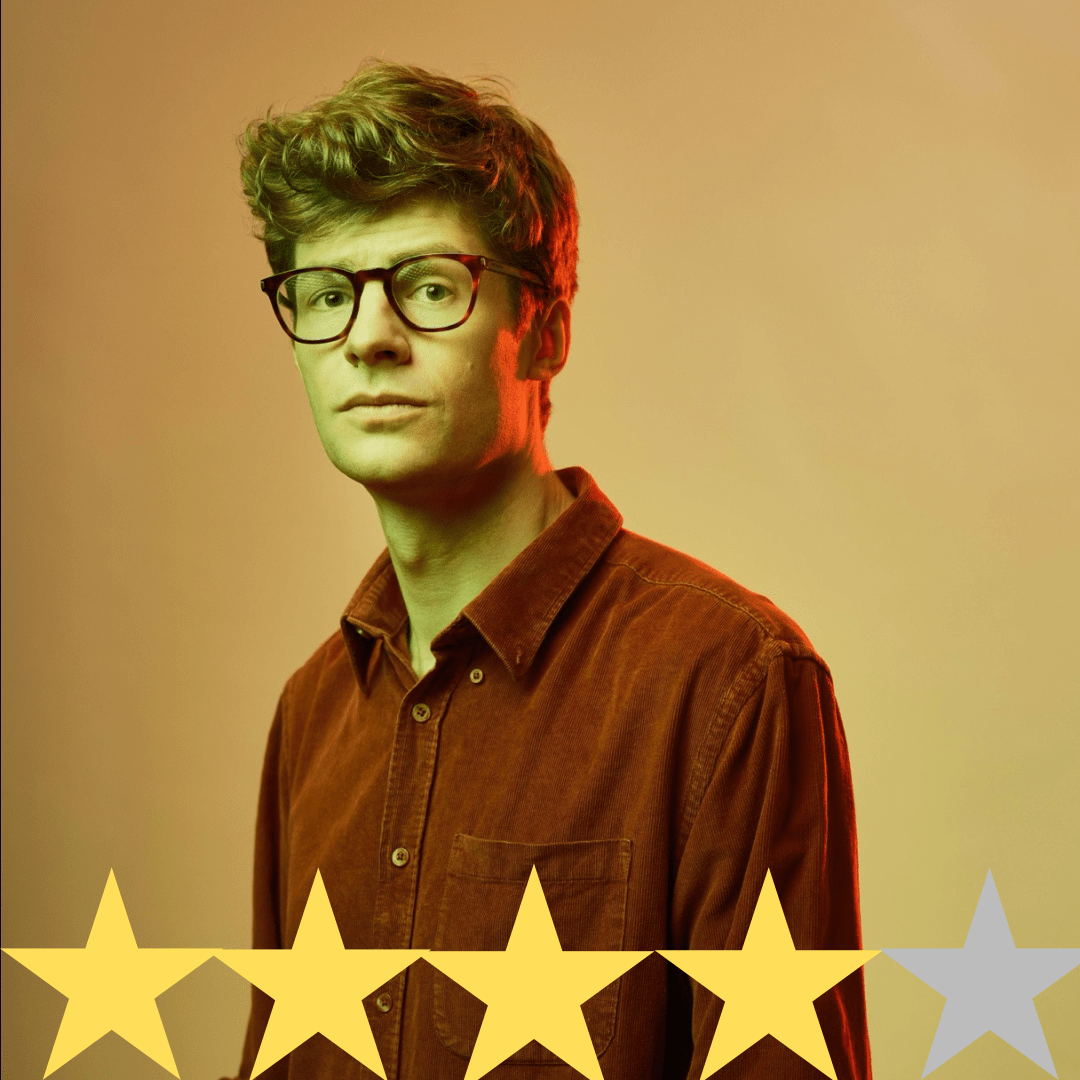
Comedy is a rather complicated beast, and no show perhaps exemplifies the challenges that a comedian may face over the course of a show’s lifespan better than Alex Kealy’s The Fear. Whilst a classic example of observationist humour covering the political and personal spectrums, the number of contextual issues over the course of the hour outwith the material ultimately detracts from the overall performance and unrestrained enjoyability of the hour.
Kealy is supported by Ben Pope, who delivers his material in such a manner that honestly reminds us of Shakespeare’s Puck, to the point where a degree of vigilance is advisable in case he gets bored and decides to stop telling jokes in favour of stealing our names or finally finding a way to displace the Pope. He takes what is perhaps a tepidly cautious audience and goes beyond his given mandate of warming the crowd up through the sheer creativity of his material and unending single-minded persistence to make us laugh to the point where the promise of comedy becomes a slight threat. Pope weaves classical and modern references to create fantastical and absurd – yet completely on point – descriptions of the mundane. In this way, Pope’s style compliments that of Kealy, creating a parallel between their comedic styles just through the use of the same technique. They both have the ability to build these layered and emotive pictures, but Pope has a tendency to push the metaphor as far as it will go to the point of absurdity, whilst Kealy’s most effective use of that technique is in the shock of the quick diffusal.
This particular performance of Kealy’s is perhaps the best example of both the level he has reached as a comedian and where he has the potential to go. His performance is less regimented and tightly-wound, as he opts for a more free-flowing posture – a more peace than war approach – which gives him the time and flexibility to improvise, exemplified in the director’s commentary of his prepared material. By engaging with his own material in this way, Kealy live-analyses his own propensity for over-analysis. It is certainly a more relaxed performance that both hinders and helps our enjoyment. The most logical explanation for this high-energy free-for-all is likely adrenaline (Kealy’s opening salvo is a Twain-esque anecdote about being harassed by a reckless driver), a high which he loses about half-way through his performance. And when that energy dissipates, his delivery suffers significantly. Kealy loses the crisp accuracy with which his jokes land as well as any potential for a quick diffusal of tension that is created through the build-up of his material, for its simply not there. His delivery becomes a lot more lost, muddled and fuzzy to the point where some of his bigger swings on punchlines cause the same kind of brain-stop as the phrase ‘eyeless hand’. Such punchlines echo in the amplified silence of the audience’s hesitancy, as whatever 4th wall Kealy initially kicks down that allows him to mic drop edgier material when his energy is at its peak, subsequently is quickly rebuilt when the energy dissipates from him, a noticeable contrast.
“Twain-esque”
The quality of the material does not change depending on the energy levels of Kealy’s performance, but our ability to engage and meet the energy of it does. Kealy’s off-the-cuff performance is very enjoyable as he is given the chance to showcase his improvisational skills and his ability to react to the context of the show rather than reciting material, showing us how he is truly involved in his performance. But in doing so, the jokes are significantly less impactful. The next steps for Kealy would be to combine the sharp, accurate and direct hits on which his material is dependent with the go-with-the-flow, reactive and improvisational posture that suits him so well.
The Fear’s lifespan encapsulates the beginning of the Labour Party’s general election win, the American General Election (which just from Kealy’s reminder feels like a lifetime ago) to the sharp downturn in popularity of the Labour Party over their handling of welfare and the conflict in Gaza, thereby becoming an example as to how the connotations and the context of a show and joke can completely change, to the point where the comedian feels the need to issue a disclaimer. Brave is not necessarily the right word here (although it was the first that came to mind), but it is definitely significant that Kealy would critique his own material in this way. It’s perhaps the best example of the living, breathing nature of a stand-up hour, the constant fine-tuning that occurs, especially for a comic like Kealy whose material is often reliant on his audiences’ memory of pop culture or politics. If anything, it’s also a relatively accurate measurement of just how long a year is.
It is a privilege in many ways to have seen The Fear at both the beginning of its life at the 2024 Fringe and at the end of this tour in 2025, to be able to observe the differences in the material, performance, delivery and context. It is truly a delight to watch Kealy not only deliver insightful commentary, but to see in real time how he moulds and pushes his comedy. His next show couldn’t be more anticipated.
By Katerina Partolina Schwartz
Photo credit: Matt Stronge
 Pepper & Salt
Leave a comment