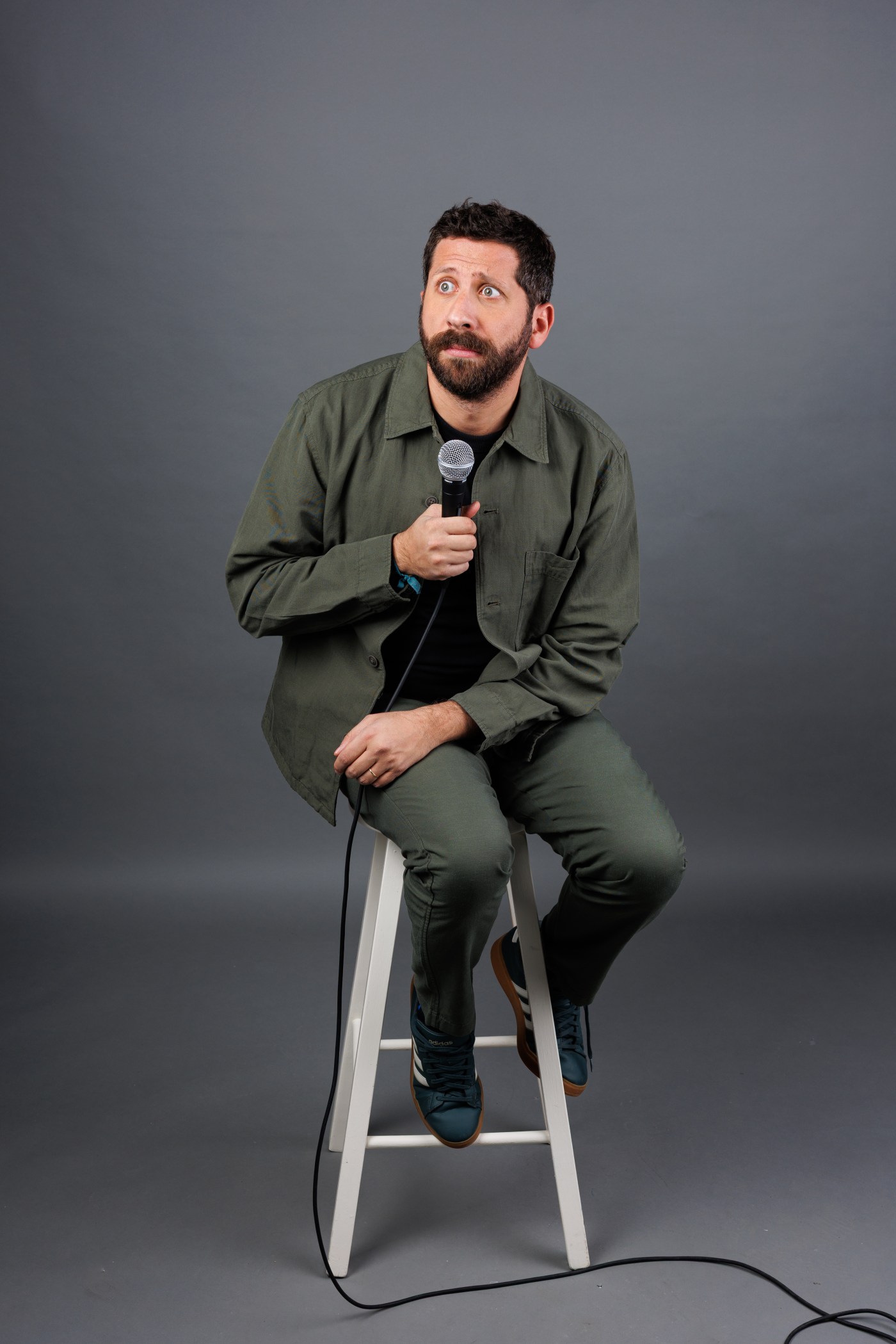
Pepper&Salt has a chat with John Achkar about his Edinburgh Fringe debut, ‘His country is collapsing. He’s having a baby. So obviously, this is the right year for a Lebanese comedian you’ve never heard of to try English stand-up for the first time’, as well as the nuances that can be found in language and comedy’s role in shared community and experiences.
How would you summarise your Edinburgh Fringe show?
For years I performed in Arabic and didn’t have to think much about whether a joke would land. I knew the room, the references, what made people laugh (I think). This year I decided to do the whole thing again in English, my third language, and find out if any of that was actually about the language at all.
The show has stories about becoming a father, about watching my country fall apart, and about deciding to start over at exactly the moment everyone told me not to.
This show isn’t really an experiment in English. It’s an experiment in empathy. I’m curious whether a room full of strangers who don’t share my language, my passport or my background can still leave feeling like we’ve known each other for years. That’s what I’m hoping to find out in Edinburgh.
What are you looking forward to about your debut?
Meeting an audience that knows absolutely nothing about me.
Nobody’s coming because they saw me online or because they’ve followed my work for years. They just want a good show.
You have to earn every laugh, and I really like that.
Is it safe to say that you’re debuting with a ‘what it says on the tin’ show and if so, how have you adapted or written the show to meet audience expectations?
Yeah, there’s no false advertising here. My country is falling apart, I just became a father, and somehow I decided this was the year to try stand-up in a language I still think in my third-best.
I used to lean on the audience already knowing something about Lebanon. Now I have to earn that same understanding in real time, mid-joke, without losing the rhythm.
What made you decide to debut at the fringe this year?
I’d been telling myself for years that my accent was the thing stopping me from doing English stand-up. Then at some point when I was performing in random lineups in US comedy clubs, I realized that wasn’t it at all. It was fear. Once I saw that, I didn’t have anywhere left to hide. Edinburgh felt like the one place that wouldn’t let me keep pretending otherwise.
How do you adapt your material, if at all to different cities/ countries?
I almost never touch the emotional core of a joke. What changes is the frame around it, how much I explain, what I assume people already know. People don’t laugh because they recognize your hometown. They laugh because they recognize themselves in it. So I spend more time making sure everyone understands why something matters than changing what happened.
Do you have a joke that you’ve had to cut or rewrite because there are things that don’t always translate exactly, either from this show or a previous one?
All the time. Arabic lets you play with rhythm, repetition and expressions in ways English doesn’t, and English has its own timing that Arabic doesn’t. Sometimes a joke that kills in Beirut becomes an explanation in London. That’s usually a sign the joke depends too much on language rather than the idea, so I end up rewriting it instead of translating it.
Just a follow-up on this, during you writing process how do you take into account various cultural contexts or nuances in humour?
I ask myself a simple question: “If someone had never heard of Lebanon, would they still understand why this is funny?” If the answer is no, I either give them just enough context or find a more universal way into the story. I don’t want audiences to feel like they’re attending a geography lesson before they’re allowed to laugh.
“Comedy makes that connection almost immediate because laughter happens instinctively, before we have time to focus on one another’s accents, backgrounds, or differences. For a moment, an entire room shares the same reaction to the same human experience.”
How would you describe your comedic style/ voice?
Observational storytelling with a lot of self-awareness. I like starting with something very specific to my life and slowly discovering it’s actually about all of us. I’m much more interested in making people recognise themselves than proving I’m clever.
What do you think is the role of comedy and stories in creating shared experiences or water cooler moments?
Stories remind us that we’re not as different as we sometimes imagine. Comedy makes that connection almost immediate because laughter happens instinctively, before we have time to focus on one another’s accents, backgrounds, or differences. For a moment, an entire room shares the same reaction to the same human experience. Those moments can continue long after the show, giving people something to talk about, relate to, and remember together.
What questions do you think we have to ask in order to bridge the gap between what we say and what we mean?
Probably fewer questions about what people believe and more about why they believe it. Everyone has a story before they have an opinion. If we’re curious enough to understand the story first, the opinion often makes a lot more sense, even if we still disagree with it.
Do you have a favourite saying or term in any language whose meaning gets lost in translation when translated into English or explained to an English-speaking person? And how would you say it relates to your show?
One Lebanese expression I love is To2borne (تقبرني), which literally translates to “may you bury me.” It sounds incredibly dark in English, but in Lebanese Arabic it’s one of the most affectionate things you can say to someone. It’s a way of saying, “I love you so much that I hope you outlive me, because I can’t imagine life without you.” What’s beautiful is that everyone says it. Parents say it to their children, grandparents say it to their grandchildren, couples say it to each other. It’s a perfect example of how language isn’t just about words, it’s about shared cultural meaning.
That’s really what this show is about. I’m not just translating jokes from Arabic into English. I’m trying to translate emotion, context, and the human experience behind the words.
Have you done anything to adapt or change about how you do comedy to fit the more ‘English style’ of standup?
I actually tried not to fit an “English style” too much.
Every country has its own rhythm, but I think audiences everywhere respond to honesty. My job wasn’t to become an English comedian. It was to become myself in English.
If you had to change your title to something else, what would it be?
Lost in Translation. Although I suspect someone has already taken that.
By Katerina Partolina Schwartz
Photo Credit: Édouard Bossé


Leave a Reply